














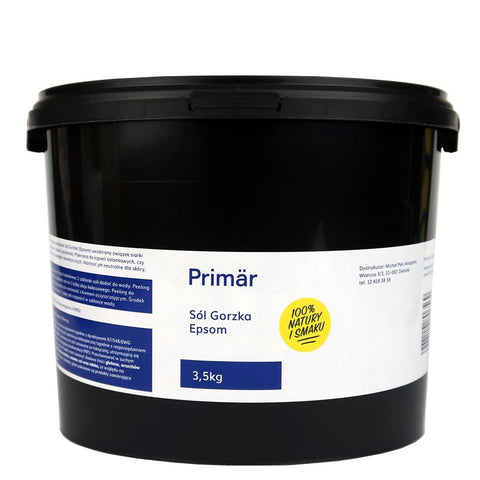
Epsom Salt - Magnesium Sulfate - Primär

Order by 12:00 and we will send your parcel today (working days)
How much does delivery cost?
- Free delivery for orders over PLN 199
- ORLEN Paczka - PLN 4.99
- InPost Paczkomaty 24/7 - PLN 14.99
- DPD Pickup - PLN 15.99
- InPost Courier - PLN 15.99
- DPD Courier - PLN 16.99
- Personal pickup in Krakow - free
What payment methods are available?
- BLIK
- fast transfer with Tpay
- Apple Pay
- Google Pay
- Credit card

THE REAL DELIVERY* – Package under warranty
We have been shipping glass jars for over 15 years and we know how to do it. If something happens during transport, you don't have to worry about anything.
Just send us a photo and a simple form, and we'll send you new products, no questions asked.
Epsom salt (also known as bitter salt or English salt) is magnesium sulfate with a purity of over 99%. Added to warm water, it turns an ordinary bath into 20 minutes of relaxation: after a workout, after a long day on your feet or before bed.
What does an Epsom salt bath do for you?
- Relaxation after a long day – your body unwinds and your mind finally gets a rest.
- A feeling of lightness for tired legs and feet – after a workout, a day of standing at work or a long walk.
- Soft, smooth skin – a soak softens the skin, including hard skin on the heels, and a salt scrub smooths it.
You'll feel the difference as soon as you step out of the bath. One or two baths a week are enough to make it a regular ritual.
How to use Epsom salt
- Relaxing bath: add 1–2 cups (approx. 250–500 g) to a warm bath and wait for the crystals to dissolve. Soak for 15–20 minutes, then rinse your body with clean water.
- Foot soak for tired feet: half a cup in a bowl of warm water, 15–20 minutes. Afterwards, hard skin on the heels is easier to remove.
- Body scrub for smooth skin: mix a handful of salt with a tablespoon of coconut oil, massage into damp skin and rinse off.
Why Primär Epsom salt?
- Over 99% magnesium sulfate – a single ingredient, with no dyes, fragrances or fillers
- Country of origin: Germany
- No scent, no foam – easy to combine with an essential oil of your choice
- Two sizes: 1 kg for 2–4 baths, 3.5 kg for 7–14 baths
Frequently asked questions
How is Epsom salt different from sea salt or Himalayan salt?
It's a different compound: magnesium sulfate rather than sodium chloride. That's why it tastes bitter and isn't used for seasoning food.
Which size should I choose?
1 kg to try it out. If you plan to take baths regularly, 3.5 kg will last several weeks and works out cheaper per kilogram.
Are there any precautions?
The salt is for external use only. Do not use it on broken or irritated skin. If you are pregnant or have a chronic condition, consult your doctor first. Store in a dry place, out of the reach of children.
Did you know? Where the name Epsom comes from
Epsom is a town in Surrey, England. According to tradition, in 1618 a farmer noticed that his cows refused to drink from one of the local springs. The water turned out to be rich in a bitter salt, later identified as magnesium sulfate, and before the end of the 17th century Epsom had become a fashionable spa town. That's why the salt is also known as English salt.
Primär is our range of conventional products: not everything can be organic, but everything can be top quality.
Nutritional value per 100 g
- energy valuen/a
- fatn/a
- including unsaturated fatsn/a
- carbohydratesn/a
- including sugarsn/a
- proteinn/a
- saltn/a


