












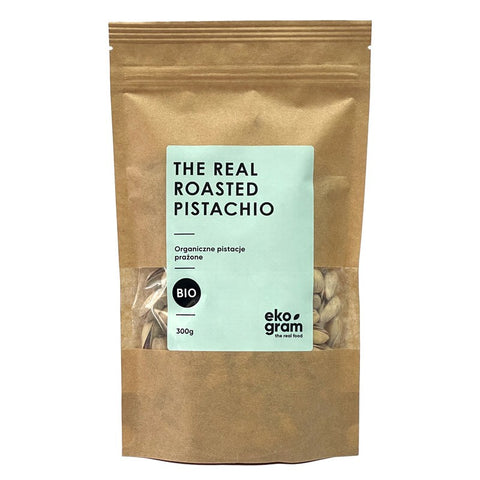
THE REAL
ROASTED PISTACHIO

49,99 zł
That is

Roasted Pistachios BIO - Salted

Quantity
49,99 zł
49,99 zł

How much does delivery cost?

  • Free delivery for orders over PLN 199
  • InPost Parcel Lockers 24/7 - PLN 14.99
  • DPD Pickup - PLN 15.99
  • InPost Courier - PLN 15.99
  • DPD Courier - PLN 16.99
  • Personal pickup in Krakow - free of charge

What payment methods are available?

  • BLIK
  • fast transfer with Tpay
  • Apple Pay
  • Google Pay
  • Credit Card

We have been shipping glass jars for over 15 years and we know how to do it. If something happens during transport, you don't have to worry about anything.

Just send us a photo and a simple form, and we'll send you new products, no questions asked.

Roasted and Salted Pistachios

Pistachios are one of those snacks whose taste everyone knows. They have stolen the hearts of children and adults alike, and their popularity has grown even more in recent years. Our pistachios are roasted and lightly salted, delighting you with their sweet and savory taste. They are a nutritious snack and a simple way to enrich your diet.

Where does the sweet and savory taste of roasted pistachios come from?

The roasting process is responsible for everything. Under the influence of temperature, the sugars and proteins present in the nut react, releasing a deep, buttery aroma. Salt is merely an addition here, making up 2.7% of the composition and not dominating the pistachio. Thanks to this, we get a unique taste that is hard to resist and stop at just one handful.

What is the difference between roasted and raw pistachios?

They differ greatly and are intended for different uses. Roasted and salted pistachios can be a snack straight from the package. Raw pistachios have a milder taste, which is why they work better as an ingredient in dishes such as pesto, creams, or artisanal ice cream. If you are looking for this version, you will find it here as unroasted and unsalted pistachios.

Pistachio nuts in the kitchen - not just for confectionery

Pistachios are primarily associated with desserts. They are a classic in ice creams, creams, and cake toppings. Chopped pistachios work great in salads, especially those with beets, citrus, or goat cheese. They can be used in breading for poultry and fish, in risotto, and as a crunchy element in hummus or roasted vegetables. A handful of pistachios with a cheese board is a simple way to prepare something interesting without effort.

Organic and reliable origin

In the package, you will find only roasted and salted pistachios, originating from organic farms. No flavor enhancers, oils, or preservatives. The pistachios are covered by the PL-EKO-03 organic certificate, which means cultivation without synthetic pesticides and artificial fertilizers, confirmed by regular inspections.

Nutritional value per 100 g

  • energy value2468 kJ / 590 kcal
  • fat53 g
  • including unsaturated fats8,6 g
  • carbohydrates16 g
  • including sugars10 g
  • protein20 g
  • salt2,5 g

Product Information

  • Ingredients: ORGANIC Nuts roasted pistachios 97.3%, salt 2.7%
  • Country of origin: Iran / USA
  • Net content: 300g
  • Certificates: Product from organic farming, covered by the certificate: PL-EKO-03 -see the certificate.
  • Allergens: The product may contain gluten, peanuts and other nuts, sesame and soy due to packaging in a plant where products containing these allergens are packaged.
  • Expiration date: The product comes from regular deliveries.

Details can be boring, but before you eat something, it's worth reading more about it.

Just one ingredient – nuts and nothing else. We don't add oil, sugar, preservatives, or beautifying agents. The only exceptions are products whose name explicitly states this, e.g., salted ones. You'll always find the full ingredient list on the label and in the product description.

Preferably in a dark, cool, and dry place – a pantry will work better than a countertop in a sunny kitchen, as nuts go rancid faster at room temperature. Also, limit their exposure to air by storing them in an airtight jar. If you want to extend their freshness for up to a year, move the jar to the refrigerator.

Roasting brings out the aroma and deepens the flavor, and the nuts become crunchier – this is the version for a snack straight from the jar. Raw nuts have a milder, creamier taste and greater versatility: they are suitable for soaking, homemade plant-based drinks, pastes, pesto, and baked goods.

A fresh nut is firm and crunchy, has an intense colour and a distinct, pleasant aroma. In a good jar, you won't find many broken pieces or finely ground meal. You'll recognise a rancid nut immediately – by its sharp, bitter aftertaste and unpleasant smell.

Depending on the variety – we import walnuts from Turkey, where walnut cultivation and consumption culture date back hundreds of years, and almonds and pistachios from Spain. Organic plantations of many varieties simply do not exist in Poland, which is why we seek the best suppliers where a given nut grows in its natural climate. The country of origin for each batch can be found on the label.

Our nuts come exclusively from certified organic farms, subject to regular inspections. In practice, this means giving up synthetic plant protection products and artificial fertilizers, and controlling the entire supply chain – from the plantation to the glass jar.

Glass is neutral to its contents – it does not let odours through, does not alter the taste and, when tightly sealed, limits air access, so nuts stay fresh and crispy longer. Once empty, the jar can be reused multiple times, so the packaging does not end its life in the bin.

The simplest way – just munch on a handful as a snack. They also work well in porridges, muesli and granola, in salads, as a topping for pasta and hot dishes, in baked goods and desserts. Ground, they turn into flour for gluten-free cakes and breadcrumbs, and blended with water – into a homemade plant-based drink.

Typically, a handful, or about 30 g per day, is recommended. Nuts are high in calories because they naturally contain a lot of fat, but they also provide unsaturated fatty acids, protein, fiber, and minerals. Such a portion is very filling and fits easily into a balanced diet.

Nuts can be introduced into a child's diet after 6 months of age, observing for any signs of allergy. However, remember that whole nuts pose a choking hazard – for children up to about 4–5 years of age, serve them only ground, grated, or in paste form, added for example to oatmeal or yogurt. If in doubt, consult a pediatrician.