

























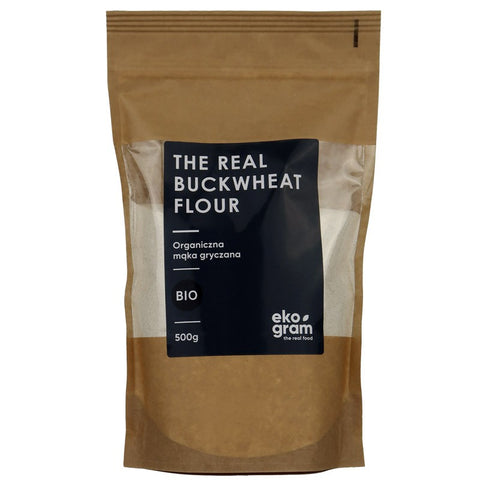
Organic Buckwheat Flour 500g

Order by 12:00 and we will send your parcel today (working days)
How much does delivery cost?
- Free delivery for orders over PLN 199
- ORLEN Paczka - PLN 4.99
- InPost Paczkomaty 24/7 - PLN 14.99
- DPD Pickup - PLN 15.99
- InPost Courier - PLN 15.99
- DPD Courier - PLN 16.99
- Personal pickup in Krakow - free
What payment methods are available?
- BLIK
- fast transfer with Tpay
- Apple Pay
- Google Pay
- Credit card

THE REAL DELIVERY* – Package under warranty
We have been shipping glass jars for over 15 years and we know how to do it. If something happens during transport, you don't have to worry about anything.
Just send us a photo and a simple form, and we'll send you new products, no questions asked.
Why is buckwheat worth rediscovering
Buckwheat has been naturally grown in South America for millennia, and from there it began to spread to other regions of the world. In Poland, a few centuries ago it was also cultivated quite often, but it was replaced by cheaper wheat. Today, buckwheat and its products are slowly returning to favor, but still its consumption in our country is low compared to the consumption of other cereals. It is worth changing this, because buckwheat, due to its nutritional value, is a very healthy product that should appear regularly in our daily diet.
A rich source of essential amino acids
Buckwheat flour is a source of easily digestible protein. What's more, it contains almost all exogenous amino acids, i.e. those that are essential for our body, but that it is not able to produce on its own. These amino acids include: lysine, tryptophan, leucine, isoleucine and proline. Their deficiency may be harmful to our health. Protein in buckwheat flour also has another, very important advantage - it does not contain gluten. This means that buckwheat flour is an excellent alternative to wheat or rye flour, which is banned in the case of gluten free products.
Vegetable fiber and bioactive substances
Buckwheat flour is also a very rich source of fiber, i.e. natural plant fiber and complex carbohydrates. Products rich in fiber should primarily be consumed by people with digestive ailments and people on a slimming diet. Buckwheat flour also contains a lot of minerals, vitamins and bioactive substances, mainly antioxidants that are very important for the body. Such a set of nutrients makes buckwheat a real treasure of health, which should be served on our plates in various forms as often as possible.
The use of buckwheat flour in the kitchen
What can you make with buckwheat flour? The Japanese make pasta out of it, the Russians prepare pancakes from it, which they then eat with caviar. And in our native cuisine, buckwheat flour can successfully replace wheat flour. It can be used for baking, both bread and sweet cakes or cookies. It has an intense aroma that makes the finished baked goods smell and taste delicious. Buckwheat flour can be used to make pies, pancakes, it can also be used to thicken soups or sauces. Including buckwheat flour in your daily diet is a great way to change your eating habits for better and healthier ones.
Nutritional value per 100 g
- energy value1516 kJ / 362 kcal
- fat2,7 g
- including unsaturated fats0,5 g
- carbohydrates65,9 g
- including sugars2 g
- protein10,8 g
- saltb.d.


