
























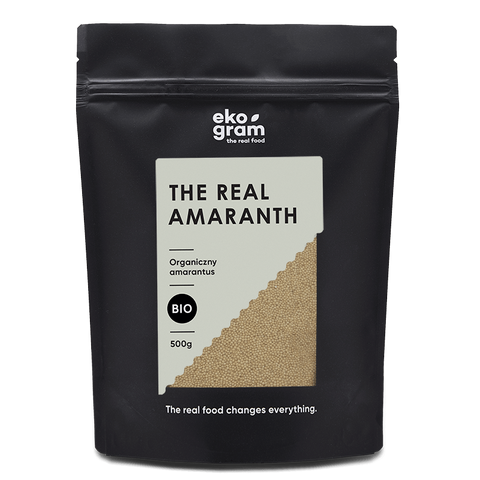
Organic Amaranth 500g

Order by 12:00 and we will send your parcel today (working days)
How much does delivery cost?
- Free delivery for orders over PLN 199
- ORLEN Paczka - PLN 4.99
- InPost Paczkomaty 24/7 - PLN 14.99
- DPD Pickup - PLN 15.99
- InPost Courier - PLN 15.99
- DPD Courier - PLN 16.99
- Personal pickup in Krakow - free
What payment methods are available?
- BLIK
- fast transfer with Tpay
- Apple Pay
- Google Pay
- Credit card

THE REAL DELIVERY* – Package under warranty
We have been shipping glass jars for over 15 years and we know how to do it. If something happens during transport, you don't have to worry about anything.
Just send us a photo and a simple form, and we'll send you new products, no questions asked.
Amaranth - What is it?
Amaranth seeds, or more precisely, grains, were a staple in the diet of the Incas and Aztecs. They believed it possessed supernatural powers. Unfortunately, its cultivation was banned by the Spanish conquistadors. It was rediscovered in the 1960s thanks to the discovery of wild varieties. To this day, it continues to gain popularity worldwide.
Why is it worth using amaranth grains regularly in our kitchen?
Amaranth is an exceptionally rich source of protein (up to 30% more than other grains), fiber, calcium, and minerals. It is gluten-free and easily digestible, making it particularly recommended for active people, vegetarians, and pregnant and breastfeeding women. It contains essential amino acids that our bodies cannot produce on their own, as well as lysine and methionine, which are not found in many grains known to man.
The smell of amaranth
Amaranth grain has a rather distinctive smell. I associate it with the smell of an old basement, but some might even associate it with mold. This is the grain's natural scent, and once cooked, it's practically imperceptible.
Watch the video on how to cook and expand amaranth
Amaranth grain – what is it from a botanical point of view?
Amaranth (Latin: Amaranthus cruentus ), also known as amaranth , is not a cereal. Due to its similar culinary uses, it is sometimes classified as a pseudo-cereal —which is precisely why it serves as an excellent alternative to traditional groats or rice.
Ecological origin
Ekogram amaranth grain comes from controlled, organic farming and is covered by the PL-EKO-03 organic certificate .
Appearance and taste of the grains
Amaranth grains are typically beige or light brown , small, and about the size of poppy seeds. When prepared, they have a slightly nutty flavor , making them suitable for both sweet and savory dishes.
What else does amaranth grain contribute to the diet?
In addition to protein and fiber , amaranth grain also provides valuable fats , including mono- and polyunsaturated fatty acids , and many minerals and vitamins. It is valued in the diet as a source of phosphorus , magnesium , iron , and zinc , as well as selected vitamins such as C and K.
Ideas for use in the kitchen
Amaranth can be used to enhance everyday dishes: as an addition to oatmeal and granola, in sweet and savory baked goods, as well as in stuffings, pâtés, casseroles, and homemade cutlets. In various cuisines around the world, it is also served as an addition to rice-based dishes or as a sweet snack.
Storage
Store in a cool and dry place , preferably in a tightly closed container , to preserve the freshness and aroma of the product.
Tip: Amaranth flour
Amaranth grains can also be made into flour by grinding them very finely (e.g., in a coffee grinder). This flour can enhance other flours in terms of nutritional value, but due to its gluten-free nature, it's not always suitable as a sole ingredient in baked goods.
Nutritional value per 100 g
- energy value1565 kJ / 371 kcal
- fat7 g
- including unsaturated fats1,5 g
- carbohydrates65 g
- including sugars1,7 g
- protein14 g
- salt0,01 g


